
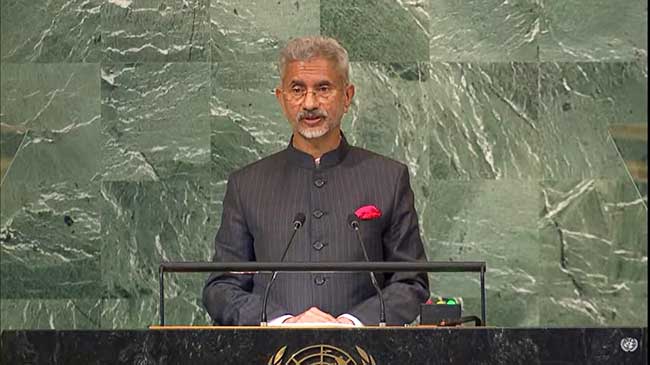
India’s External Affairs Minister S Jaishankar on Tuesday declared India a "Vishwa Mitra", a friend of the world, that will be a bridge-builder, but will also challenge the power structure and give voice to South as it claims its due.
"When we aspired to be a leading power, this is not for self-aggrandisement, but to take on greater responsibility and make more contributions," he said at the high-level meeting of the General Assembly.
"All nations pursue the national interests (but) we, in India, have never seen that as being in contradiction with global good," he said.
Outlining India’s role, he said: "From the era of non-alignment, we have now evolved to that of Vishwa Mitra, a friend to the world.
"This is reflected in our ability to engage with a broad range of nations and when necessary, harmonise interests."
The New Delhi G20 Summit presided over by India "affirms that diplomacy and dialogue are the only effective solutions. The international order is diverse. And we must cater for divergences, if not differences. The days when a few nations set the agenda and expected others to fall in line are over", he said.
"Our vision of ‘One World, One Family, One Future’ sought to focus on the key concerns of the many, not just the narrow interests of a few," he said.
The outcomes of the New Delhi G20 Summit that brought development and restructuring the global financial order to the fore "will surely resonate for years ahead", he asserted.
Of his nation’s future, Jaishankar said: "As a civilisational polity that embraces modernity, we bring both tradition and technology equally confidently to the table. It is this fusion that today defines India that is Bharat.
"India has entered the ‘Amrit Kaal’, a quarter century, where greater progress and transformation awaits us."
"The world saw a glimpse of what is to come when our Chandrayaan 3 landed on the moon," he said.
Jaishankar challenged the existing global power structure as a multipolar world emerges: "The days when a few nations set the agenda and expected others to fall in line are over.
"It is still a few nations who shape the agenda and seek to define the rules. This cannot go on indefinitely, nor will it go unchallenged. A fair, equitable and democratic order will surely emerge once we all put our minds to it."
He said that the way out of this is to find common grounds as was demonstrated at the G20 Summit, where India forged a consensus. "In the words of Prime Minister Narendra Modi, it was to bridge divides, dismantle barriers and sow seeds of collaboration that nourish a world where unity prevails over discord and where shared destiny eclipses isolation," Jaishankar said.
"Finding common ground is an imperative to listen to others and to respect the viewpoints," he said.
"This is not weakness, it is the basics of cooperation. Only then, can collective efforts on global issues be successful."
India’s foreign policy’s evolution from nonalignment to Vishwa Mitra, he said "is reflected in our ability to engage with a broad range of nations and when necessary, harmonise interests".
He cited the examples of the BRICS, where India stands alongside Russia and China, and the multi-national arrangements with the US at the centre. The Vishwa Mitra policy “is visible in the rapid growth of the Quad, a mechanism today so relevant to the Indo-Pacific (of India, the US, Japan and Australia)".
"It is equally apparent in the expansion of the BRICS grouping of independent-minded nations, or in fact, the emergence of the I2U2 (of India, Israel, the US and the UAE) combination," he said.
"Recently, we hosted the creation of the India-Middle East-Europe, economic corridor" that was announced by Prime Minister Narendra Modi and US President Joe Biden at the G20 Summit.
"This willingness to work in an open-minded manner on specific domains is now a defining characteristic of the emerging multipolar order," he said.
Jaishankar did not mention any country by name, although there were general criticisms of the West and a hint to China of India’s commitment with the Quad to a secure, non-hegemonist Indo-Pacific. Nor did he address Russia’s invasion of Ukraine, where India is caught uncomfortably between its historic ties with Mosco and its growing relations with the West based on geopolitical and economic interests. In a glancing reference, he said that "respect for territorial integrity" – often used to criticise Russia’s invasion – should not be determined by "political convenience determines responses to terrorism, extremism and violence. Similarly, respect".
On terrorism, where Pakistan and some other countries subscribe to double standards, he said that political convenience should not determine "responses to terrorism, extremism and violence".
As for “non-interference in internal affairs (it) cannot be exercises in cherry picking," he said. "When reality departs from the rhetoric, we must have the courage to call it out," he said.
Voicing the grievances of the South, he said, “We must never again allow an injustice like vaccine apartheid (when developed countries initially hogged the supply) to recur. Climate action too cannot continue to witness an evasion of historical responsibilities (of industrialised countries that caused the buildup of greenhouse gases)".
Nor, he said, "the power of markets should not be utilised to steer food and energy from the needy to the wealthy" as has happened in the aftermath of the Russian invasion of Ukraine. At the G20 Summit, "we gave voice to an entire continent, which has long been it's due" by admitting the African Union as a permanent member of the G20, he said.
"This significant step in reform should inspire the United Nations, a much older organisation to also make the Security Council contemporary," he said.
"Broad representation is after all, a prerequisite for both effectiveness and credibility."
India can be a model for other developing nations, he said. "Our message to the world is in digitally enabled governance and delivery, in the widening ambit of amenities and services, in rapidly growing infrastructure, and in our energetic startup culture," he said.
"It is visible to you In vibrant cultural expressions, such as in the arts, yoga, wellness and lifestyle," he said.

Tripura BJP to Focus on Organisational Strength Ahead of Upcoming Polls
BJP state president Abhishek Debroy has said that strengthening the party organisation at every level will remain the BJP's top priority as it prepares for the upcoming electoral battles in the state.
Governor Urges Mass Participation in Anti-Drug Drive at Tripura University
Calling drug addiction one of the most serious challenges confronting society, Governor Indra Sena Reddy Nallu urged citizens to join hands in the fight against narcotics, stressing that a drug-free society can only be achieved through collective public participation.
IGP holds review meeting in Gomati, stresses on intelligence-based policing
Tripura Police’s Inspector General of Police (IGP), Law and Order Branch, Manchak Eppar, IPS, visited the Gomati District Police Headquarters to assess the district’s law and order situation, crime prevention strategies and the overall progress of policing activities.
Stolen auto recovered from in Bishramganj, police launch probe
Bishramganj Police have recovered a stolen CNG auto-rickshaw from a rubber plantation near the new petrol pump area along the National Highway late Saturday night.
Auto Drivers Protest Traffic Enforcement in Kamalasagar
Tension briefly flared in the Lembutuli area of Kamalasagar on Sunday after an enforcement drive against the use of black window films (sun-control films) on vehicles led to a confrontation between Bishalgarh Police and auto-rickshaw drivers.
Garbage dumping row triggers protest in Kamalpur
Alleged dumping of garbage into a privately owned pond in Rishipara under Ward No. 2 of the Kamalpur Nagar Panchayat in Dhalai district has sparked outrage among local residents, who have demanded immediate intervention by the administration to address the growing environmental and public health concerns.
Police personnel accused of performing duty under influence of alcohol at Mata Bari; Probe Demanded
Allegations that a police personnel was performing duty under the influence of alcohol at the revered Mata Tripura Sundari Temple in Udaipur, Gomati district, have triggered widespread concern, with the incident drawing significant attention on social media.
Woman dies, minor injured after car crashes into house in South
A 45-year-old woman lost her life and a 10-year-old girl was injured after a WagonR car allegedly went out of control and hit them near Kalachhara Railway Station in South Tripura district on Sunday morning.