
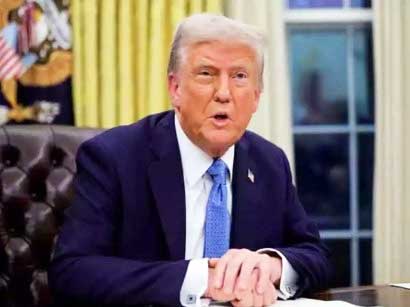
As global stock markets plunged on Monday, US President Donald Trump defended his controversial tariff policies, dismissing concerns over the economic impact. He said that the world leaders are "dying to make a deal" to negotiate the reciprocal tariffs.
With Asian markets opening to significant losses and US futures signalling further declines, Trump sought to downplay fears, suggesting that the market pain caused by his tariffs was a necessary "medicine" to fix longstanding trade imbalances.
On Sunday, Trump denied any intent to deliberately engineer a market selloff, insisting that he could not predict market reactions. He emphasised that he would not enter trade agreements with other countries unless they addressed the trade deficits.
"Sometimes you have to take medicine to fix something," Trump said, referring to the market volatility.
Since the onset of his tariff policies, trillions of dollars in market value have been wiped off the books of US companies, with investors bracing for further fallout.
Trump added that any market adjustment would be "temporary," soft-pedalling the severity of the situation.
Speaking to reporters aboard Air Force One, the US President added that he had been in contact with world leaders over the weekend and claimed that many countries were eager to negotiate a deal.
"They're dying to make a deal," he said, reiterating his stance that tariffs were a necessary tool to level the global playing field.
Despite the steep losses in global markets, which many feared could trigger a full-blown economic downturn, the Trump administration showed no signs of backing off from its aggressive tariff strategy.
China, in particular, announced retaliatory measures, further fueling concerns of an escalating trade war.
Economists have warned that if the US continues on its current path, the global economy could face a severe downturn.
Bruce Kasman, Chief Economist at JPMorgan, put the risk of a recession at 60 per cent, citing the potential for Trump's trade policies to tip a healthy global expansion into a crisis.
The turmoil in the markets has sparked comparisons to the 1987 "Black Monday" crash, which saw global markets lose $1.71 trillion in a single day.
CNBC's Jim Cramer warned that if Trump's trade policies continue, markets could face a similar catastrophic event. As the markets brace for another volatile week, all eyes remain on the White House and the next steps in the ongoing trade conflict.

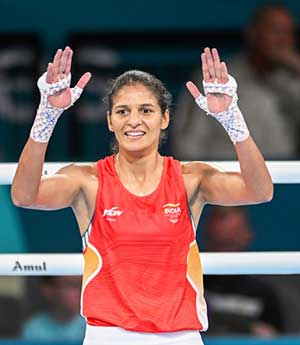

CWG 2026: Preeti, Jaismine, Sakshi, Sachin win as India rule boxing ring with seven gold
Indian boxing scripted history at the Commonwealth Games 2026 in Glasgow on Saturday by bagging seven gold medals — the highest-ever gold haul for the country in the competition.
Five NE states record below-normal monsoon rainfall in June-July despite widespread floods
Even as several Northeastern states were battered by heavy rains, floods and landslides during July, five of the region's eight states recorded below-normal monsoon rainfall so far due to weak rain-bearing systems over the Bay of Bengal, the absence of active monsoon troughs and the influence of El Nino, India Meteorological Department (IMD) officials said on Saturday.
Blood donation movement witnessing a renaissance in Tripura: CM
Chief Minister Prof. Dr. Manik Saha today said that there is currently a renaissance in the blood donation movement in the state. Along with creating a sense of spirituality through blood donation, a sweet bond is developed between the blood donor and the recipient.
Residents allege irregularities in Dharmanagar–Kailashahar road repair work, seek official inquiry
Allegations of irregularities have surfaced in the ongoing maintenance work on the Dharmanagar–Kailashahar road, with local residents claiming that the project is not being executed in accordance with the approved work order. They have urged the authorities to conduct a detailed investigation into the matter.
Sports Minister inspects construction of youth hostel in Kailashahar
Tripura Sports and Youth Affairs Minister Tinku Roy on Saturday inspected the ongoing construction of a 200-bed Youth Hostel at Ward No. 14 of the Kailashahar Municipal Council in Unakoti district. Senior officials of the concerned department accompanied the minister during the visit.
Infant found dead in well in North district
A pall of grief and shock has descended on North Gopalpur village in North Tripura district after the body of a 12-day-old baby girl was recovered from a well early on Saturday morning.
Ahmedabad to officially receive Commonwealth Games Flag, Host Baton at Glasgow closing ceremony
Ahmedabad's preparations to host the centenary edition of the Commonwealth Games will formally begin on Sunday when the city receives the Commonwealth Games flag and the Host Baton during the closing ceremony of the 2026 Commonwealth Games in Glasgow.
AGMC to be top medical, research centre in NE: Tripura CM
Tripura Chief Minister Manik Saha on Saturday said the state government is working relentlessly to transform the Agartala Government Medical College (AGMC) and Govind Ballabh Pant Hospital into one of the best medical education, research and super-speciality healthcare institutions in Northeast India, while strengthening the state’s overall healthcare ecosystem.