
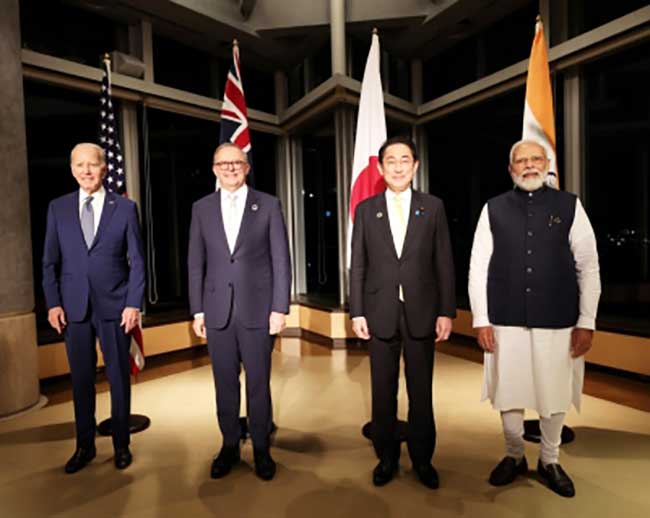
Leaders of the Quad countries -- India, Australia, Japan and the United States -- on Saturday reiterated their call for resolution of the war in Ukraine through dialogue and diplomacy, saying "ours must not be an era of war", using a signature formulation delivered by Prime Minister Narendra Modi to Russian President Vladimir Putin in a face-to-face meeting.
The Quad leaders, who held their third in-person summit in Hiroshima on the sidelines of the G-7 summit, also condemned Putin's threat - without naming him - to use nuclear weapons as "serious and inadmissible", amplifying India's own outrage over the threats that had made it cancel an annual bilateral summit with Russia.
The four leaders also said they "strongly oppose destabilising or unilateral actions that seek to change the status quo by force or coercion", without naming China, which has aggressively pushed its territorial claims in the region, including against India.
Further, they condemned terrorism and violent extremism in all forms and cross-border terrorism and called for punishing those responsible for the 26/11 Mumbai terror attacks; reiterated demand for reforming the UN to expand the Security Council; condemned "destabilising ballistic missile launches" and urged for demilitarisation of the Korean peninsula; and expressed concern over the "deteriorating" situation in Myanmar.
Prime Minister Modi did not touch upon Ukraine in his remarks at a joint appearance with the Quad leaders, and focused on the grouping's regional context.
"Through our shared efforts, we are giving a practical dimension to our vision for a free, open and inclusive Indo-Pacific," he said, deploying a formulation used to convey the group's determination to counter China's aggressive intent in the region.
"Climate action, disaster management, strategic technologies, reliable supply chains, health security, maritime security, counter-terrorism are examples of areas in which our positive cooperation is increasing," he said.
Modi, Australia Prime Minister Anthony Albanese, Japan Premier Kishida Fumio and US President Joe Biden held the first in-person summit in Hiroshima on the sidelines of the G-7 summit. They made brief opening remarks before their meeting, which was followed by the release of a vision statement, a joint statement and a factsheet breaking down the progress from the first summit held in Washington in 2021 to the second held in Tokyo in 2022 and, now, the third.
This summit was to be held in Australia, but was relocated to Japan where all the leaders were expected to be for the G-7 summit (India and Australia are invitees, not members of the group). The relocation was forced upon the group by Biden's decision to cancel the Australia leg of his visit because of the ongoing negotiations in Washington with Republicans to raise the debt limit with the looming deadline of June 1.
The third summit became, in effect, the shortest yet, lasting no more than 45 minutes, according to Biden's schedule released by the White House on Friday.
But the documents released and initiatives launched at the summit were anything but brief or inconsequential.
"Our vision is for a region that is peaceful and prosperous, stable and secure, and respectful of sovereignty � free from intimidation and coercion, and where disputes are settled in accordance with international law," the four leaders said in a vision statement.
"We seek a region in which all countries and people can exercise free choice on how they cooperate and trade based on partnership, equality and mutual respect. We share the belief that engaging openly, transparently and constructively creates more opportunities, greater economic vitality and better understanding of shared challenges, to the benefit of all."
The four leaders launched several new joint initiatives at the summit in fields ranging from health to AI technology to climate change to trade to maritime security.
Some of them built upon the existing programmes, such as Covid vaccine cooperation initiative, which has been expanded into a broader Quad Health Security Partnership. It will include a "suite of activities to build the region's capacity to detect and respond rapidly to outbreaks of diseases with epidemic and pandemic potential".
Ongoing cooperation on infrastructure building will get an additional boost from the Quad Infrastructure Fellowships Programme, a new initiative launched, the joint statement said, to empower more than 1,800 of the region's infrastructure practitioners to design, build and manage quality infrastructure in their home countries.
The "Quad Partnership for Cable Connectivity and Resilience" was the other new initiative launched by the leaders. This will seek to strengthen cable systems in the Indo-Pacific, drawing on, the statement said, Quad countries' world-class expertise in manufacturing, delivering and maintaining cable infrastructure.
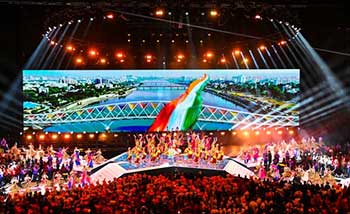
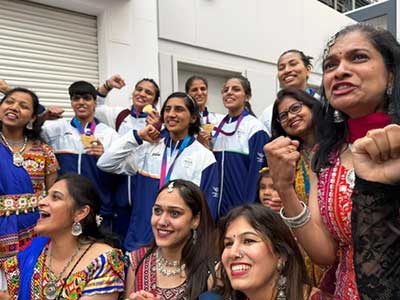

CWG 2026: Ahmedabad 2030 takes centre stage as Glasgow signs off with spectacular closing ceremony
There are evenings that are remembered for their grandeur, and then there are evenings that leave an entire arena buzzing with emotion. The closing ceremony of the 2026 Commonwealth Games at Glasgow’s OVO Hydro belonged firmly in the latter category, with India’s spectacular cultural showcase stealing the spotlight and setting the stage for Ahmedabad 2030.
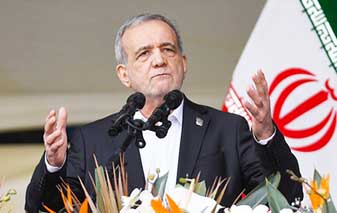
Iran's president says necessary to make US adhere to MoU
Iranian President Masoud Pezeshkian said that Iran must "compel" the United States to remain committed to the peace memorandum of understanding (MoU) signed between the two countries.
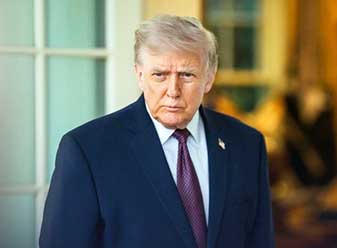
Trump announces fresh Iran talks amid Gulf mediation efforts
US President Donald Trump said that negotiations with Iran will begin Monday afternoon, noting that Saudi Arabia, the United Arab Emirates (UAE) and Qatar had asked the United States to call off planned strikes because "they think there's a deal."
Arunachal’s January Tali, Hachu Lombo become first state women to scale 7,077-metre Mt Kun
Two women mountaineers from Arunachal Pradesh have scripted history by becoming the first women from the state to successfully scale the 7,077-metre-high Mt Kun in the Zanskar region of Ladakh, bringing laurels to the border state, officials said on Sunday.
Tripura BJP to Focus on Organisational Strength Ahead of Upcoming Polls
BJP state president Abhishek Debroy has said that strengthening the party organisation at every level will remain the BJP's top priority as it prepares for the upcoming electoral battles in the state.
Governor Urges Mass Participation in Anti-Drug Drive at Tripura University
Calling drug addiction one of the most serious challenges confronting society, Governor Indra Sena Reddy Nallu urged citizens to join hands in the fight against narcotics, stressing that a drug-free society can only be achieved through collective public participation.
IGP holds review meeting in Gomati, stresses on intelligence-based policing
Tripura Police’s Inspector General of Police (IGP), Law and Order Branch, Manchak Eppar, IPS, visited the Gomati District Police Headquarters to assess the district’s law and order situation, crime prevention strategies and the overall progress of policing activities.
Stolen auto recovered from in Bishramganj, police launch probe
Bishramganj Police have recovered a stolen CNG auto-rickshaw from a rubber plantation near the new petrol pump area along the National Highway late Saturday night.