
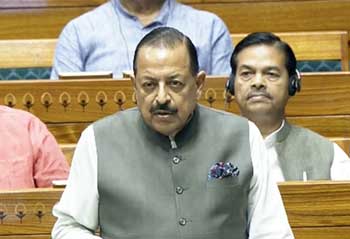
Union Minister Dr Jitendra Singh on Tuesday said the Narendra Modi-led Central government was committed to strengthening the examination system and ensuring swift justice in cases of paper leaks and examination malpractices.
Opening the debate on the Public Examinations (Prevention of Unfair Means) Amendment Bill, 2026, in the Lok Sabha, he said the government's intent could be seen not only in introducing a stronger law but also in initiating the process of setting up special fast-track courts to deal exclusively with such offences.
Singh recalled that the Public Examinations (Prevention of Unfair Means) Act, enacted in 2024, had already been made applicable to all testing agencies across the country.
"It was made non-bailable, non-compoundable, and cognisable, with stringent punishment. However, considering recent events, Prime Minister Modi decided that the Act needed to be strengthened. This amendment is being brought to make the law more stringent and ensure speedy justice, to enhance the credibility of examinations," he said.
Detailing the proposed changes, the minister said the penalties for service providers (any agency, organisation, company or firm engaged in conducting public examinations) involved in examination-related malpractice had been substantially enhanced under the amendment.
The maximum financial penalty for such service providers has been increased from Rs 1 crore to Rs 5 crore. In addition, the period during which such entities would be barred from conducting public examinations has been doubled from four years to eight years, he said.
"Therefore, any service provider found guilty of misappropriation or malpractice resulting in such consequences will be prohibited from conducting any public examination for the next eight years," Singh said.
He said the proposed legislation seeks to ensure that every individual or organisation directly or indirectly involved in examination-related offences is held accountable, thereby creating a strong deterrent against future malpractice.
The minister also said the amendment proposes stricter punishment for directors and senior management of organisations found guilty. While the existing Act provided for imprisonment ranging from three to ten years, the proposed amendment increases the minimum punishment to five years while retaining the maximum sentence of ten years. The maximum fine has also been increased from Rs 1 crore to Rs 5 crore.
Referring to organised examination-related crime, Singh said the government had taken into account the growing nexus involving examination mafias and other organised networks operating across different states, irrespective of the political party in power.
"In cases involving organised crime, where an examination mafia or criminal nexus is found, as we have experienced, I am not accusing any particular government. As I said in the beginning, this is a widespread problem faced by almost every state and Union Territory, irrespective of which party is in power. It is happening in Punjab; it is happening in Karnataka, whether we name those states or not," he said.
"For organised crime involving examination authorities or service providers, the earlier punishment was imprisonment of 5-10 years. It is now proposed to be increased to 7-10 years. Likewise, the maximum fine, which was Rs 1 crore earlier, is proposed to be increased to Rs 10 crore," Singh added.
Highlighting what he described as one of the most significant provisions of the amendment, the Minister said Prime Minister Modi had emphasised the importance of ensuring "speedy justice" through dedicated fast-track courts.
"The most important thing which Prime Minister Modi also mentioned in his video message is to ensure speedy justice. We will have special fast-track courts established only for cases dealing with unfair means in examinations. Whether it is a special task force or a central agency, this bill and the earlier bill authorise the government to refer such cases to any central agency, a special task force, or even the police where it is conducting the investigation. For this, Section 12A has been added to this earlier Bill, which provides for special fast-track courts," he said.
Singh further said the government had also incorporated fixed timelines for investigation and trial to ensure that cases are concluded without unnecessary delays.
"The investigation has to be completed within two months, regardless of whether it is a central agency or a special task force. After that, the trial court, which will be a fast-track special court, will have three months. From the day the incident is reported to the final decision, the total duration shall not exceed five months," he added.
Singh said that if anyone wishes to appeal, the appeal will be heard by a division bench of a High Court, and it must be filed within 30 days, provided there are justifiable grounds. He said that other crimes related to this will also not go unattended, and provisions under the Bharatiya Nyaya Sanhita will apply.
"This is an important bill. The government's commitment can be gauged from the fact that along with bringing this bill, our Law Minister has initiated the process to establish these special fast-track courts. They have already been set up in Delhi, Mumbai, Kolkata, Madhya Pradesh, Bihar, and Uttarakhand, and will be set up in other places soon," he added.
The Minister also informed the House that Prime Minister Modi had constituted a high-level task force, led by Infosys co-founder Nandan Nilekani, to recommend comprehensive reforms aimed at making the country's examination system "leak-proof."
He mentioned that the K. Radhakrishnan committee, constituted on June 22, 2024, had made 46 key recommendations, out of which 76 per cent, that is 35, have already been implemented.
"The government's policy is responsible, and this amendment is being brought with an honest effort. I believe no leader or respected member of any party will have any objection to it. If they do, the people of the country will object to them," Singh said.

Tripura: Rooftop solar capacity crosses 15 MW under PM Surya Ghar scheme
A quiet energy revolution is taking shape across Tripura, where an increasing number of households are transforming their rooftops into clean energy generation units under the PM Surya Ghar: Muft Bijli Yojana (PMSGMBY), officials said on Tuesday.
Tripura CM urges tapping capital markets for self-reliance
Tripura Chief Minister Manik Saha on Tuesday said the state must become an active participant in India’s financial growth story by building institutional capacity, promoting financial literacy, and encouraging entrepreneurs and public institutions to tap capital markets to create a financially self-reliant and prosperous Tripura.
Special investigation team constituted to probe former DGP's death
The Superintendent of Police, West Tripura Namit Pathak who was assigned to investigate the death of Tripura DGP Anurag Dhankar, has constituted a Special Investigation Team (SIT) to conduct a thorough, coordinated and expeditious investigation into the death of former Tripura Director General of Police
Sushanta reviews prep for kharif marketing season CMR production
Tripura Food, Civil Supplies and Consumer Affairs Minister Sushanta Chowdhury on Tuesday chaired a high-level review meeting with owners of empanelled rice mills to assess the state's preparedness for the upcoming Kharif Marketing Season (KMS) 2026–27.
Tripura’s ‘Tripureswari Veena’ earns Indian patent, showcasing state’s cultural innovation
In a proud moment for Tripura's cultural and artistic community, noted Indian classical musician Dr. Jayanta Sarkar has secured an Indian patent for his newly developed string instrument, the 'Tripureswari Veena'. The patent, granted by the Government of India, marks a significant achievement in the fields of music, innovation and traditional craftsmanship.
Delhi High Court orders winding up of Paytm Payments Bank: RBI
The Delhi High Court has ordered the winding up of Paytm Payments Bank Limited (PPBL), months after the Reserve Bank of India (RBI) revoked the bank's licence over persistent regulatory violations, marking the final step in the lender's closure process, the central bank said on Tuesday.
Youngsters know how to make govt yield, thank new generation for morale: Akhilesh Yadav
Samajwadi Party (SP) chief Akhilesh Yadav on Tuesday asserted that the country's youth had demonstrated their ability to make the government respond to public demands, saying the recent student movement over examination irregularities compelled the Centre to concede several demands.
'PM Modi clocked it, provided a legislative solution': Bansuri Swaraj on anti-paper leak bill
BJP MP Bansuri Swaraj on Tuesday said that Prime Minister Narendra Modi "clocked" the examination system and "provided a legislative solution", using a Gen Z term while participating in the debate on Public Examinations (Prevention of Unfair Means) Amendment Bill, 2026.