
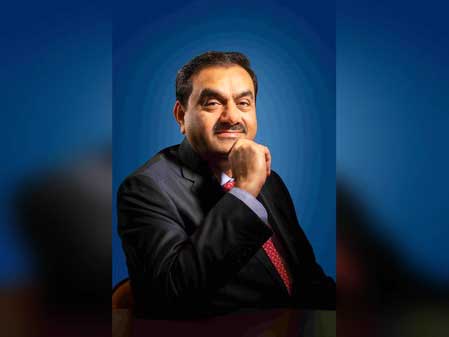
For most of modern history, the sequence was predictable. Physical infrastructure came first -- roads, ports, power plants -- and technology followed, amplifying what had already been built. Adani Group Chairman Gautam Adani believes that sequence has fundamentally changed.
In his annual message for the financial year 2026, he makes the case that infrastructure and intelligence now reinforce each other from the ground up.
Before AI can think, energy must flow; before data can move, infrastructure must stand. Seen through this lens, the Adani Group's portfolio -- spanning ports, airports, energy, transmission, logistics, data centres and manufacturing -- is not a collection of disparate businesses, but a single integrated platform designed to connect the physical and digital worlds.
The Adani Group Chairman's central argument is that the next era of competitive advantage will not belong to organisations with scattered interests, but to those capable of combining infrastructure, energy, technology and execution into a unified system.
Long before AI became the defining technology conversation of our time, the Adani Group had already begun building the physical foundation required to support it.
The FY26 numbers reflect that strategy in full. The Adani Group invested more than Rs 1.5 lakh crore during the year -- one of the largest capital deployment programmes in corporate India. Renewable energy capacity crossed 19.3 GW following the addition of 5.1 GW during the year. The transmission order book expanded to Rs 71,779 crore.
Adani Ports handled more than 500 million tonnes of cargo. The greenfield Navi Mumbai International Airport, one of India's largest aviation infrastructure projects, advanced the Adani Group's vision of integrated transport and connectivity networks. And the data centre business continued its journey towards a 2 GW platform by 2030.
Each of these milestones, Gautam Adani suggests, is part of a deliberate effort to build the backbone of India's next phase of growth -- not simply as assets in isolation, but as interconnected capabilities designed to reinforce one another at scale.
The argument carries particular weight at a moment when countries worldwide are confronting energy security concerns, supply chain disruptions and the infrastructure demands of AI adoption. The race for technological leadership, Gautam Adani contends, is increasingly a race for infrastructure readiness — where reliable power, connectivity and industrial capacity matter as much as innovation itself.
India enters this moment with a structural advantage that many mature economies do not possess. Rather than retrofitting ageing systems, it has the opportunity to build physical and digital infrastructure in tandem -- renewable energy, storage, logistics, ports, airports and data centres evolving as interconnected systems rather than standalone investments.
For Gautam Adani, the stakes extend well beyond economics. Throughout his message, he connects infrastructure to sovereignty, resilience and national capability — in energy security, digital infrastructure, defence manufacturing and critical supply chains. The underlying logic is unambiguous: nations that control the foundations of growth will be better positioned to navigate an increasingly uncertain world.
Perhaps the most telling observation in the Adani Group Chairman's message is that the challenge has shifted — from funding growth to building fast enough to meet demand. It signals not only confidence in India's long-term trajectory, but a recognition that execution has become the defining competitive edge. The era of capital scarcity has given way to one where the ability to deploy capital efficiently, consistently and at scale is the true differentiator.
Gautam Adani's FY26 message, at its core, is a bet on the decade ahead. Infrastructure gives a nation muscle; intelligence gives it mastery. But it is the convergence of both — delivered at speed and at scale — that will define the next era of global growth. India, he believes, is uniquely positioned to lead it.
The task is not simply to build more. It is to build the physical and digital foundations of a nation poised to define its century.

CWG 2026: Preeti, Jaismine, Sakshi, Sachin win as India rule boxing ring with seven gold
Indian boxing scripted history at the Commonwealth Games 2026 in Glasgow on Saturday by bagging seven gold medals — the highest-ever gold haul for the country in the competition.
Five NE states record below-normal monsoon rainfall in June-July despite widespread floods
Even as several Northeastern states were battered by heavy rains, floods and landslides during July, five of the region's eight states recorded below-normal monsoon rainfall so far due to weak rain-bearing systems over the Bay of Bengal, the absence of active monsoon troughs and the influence of El Nino, India Meteorological Department (IMD) officials said on Saturday.
Blood donation movement witnessing a renaissance in Tripura: CM
Chief Minister Prof. Dr. Manik Saha today said that there is currently a renaissance in the blood donation movement in the state. Along with creating a sense of spirituality through blood donation, a sweet bond is developed between the blood donor and the recipient.
Residents allege irregularities in Dharmanagar–Kailashahar road repair work, seek official inquiry
Allegations of irregularities have surfaced in the ongoing maintenance work on the Dharmanagar–Kailashahar road, with local residents claiming that the project is not being executed in accordance with the approved work order. They have urged the authorities to conduct a detailed investigation into the matter.
Sports Minister inspects construction of youth hostel in Kailashahar
Tripura Sports and Youth Affairs Minister Tinku Roy on Saturday inspected the ongoing construction of a 200-bed Youth Hostel at Ward No. 14 of the Kailashahar Municipal Council in Unakoti district. Senior officials of the concerned department accompanied the minister during the visit.
Infant found dead in well in North district
A pall of grief and shock has descended on North Gopalpur village in North Tripura district after the body of a 12-day-old baby girl was recovered from a well early on Saturday morning.
Ahmedabad to officially receive Commonwealth Games Flag, Host Baton at Glasgow closing ceremony
Ahmedabad's preparations to host the centenary edition of the Commonwealth Games will formally begin on Sunday when the city receives the Commonwealth Games flag and the Host Baton during the closing ceremony of the 2026 Commonwealth Games in Glasgow.
AGMC to be top medical, research centre in NE: Tripura CM
Tripura Chief Minister Manik Saha on Saturday said the state government is working relentlessly to transform the Agartala Government Medical College (AGMC) and Govind Ballabh Pant Hospital into one of the best medical education, research and super-speciality healthcare institutions in Northeast India, while strengthening the state’s overall healthcare ecosystem.